

Monday, February 2, 2026
spot_img
Home Blog Page 240

Guam Rhino Beetle

0

I’m a fan of beetles, it’s sad that the beetles are harming one of Guam’s best natural resources.  I’m glad there are there are scientists like Cathleen Moore-Linn to work on a solution.

In May 2008 the island of Guam became a living laboratory for scientists as they attached acoustic equipment to coconut trees in order to listen for rhinoceros beetles. A grant from USDA IPM allowed Richard Mankin, a recognized world-class expert on acoustic detection of insects, to travel to Guam to collaborate with island scientists on the Guam Coconut Rhinoceros Beetle Eradication Project. The results of this research were recently published in the journal Florida Entomologist.

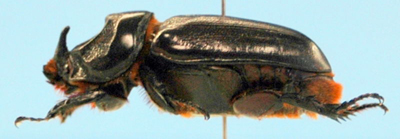
The coconut rhinoceros beetle, Oryctes rhinoceros, is a serious pest of coconut palms and was discovered on Guam September 11, 2007. University of Guam entomologist, Aubrey Moore worked with Mankin to analyze the spectral and temporal patterns of stridulations produced by the rhino beetles. Recordings were made of beetles and larvae that were reared at the university. Field recordings were also made of beetles and larvae in coconut trees and logs.

Digitized signals were analyzed with several types of software, which distinguished intervals and amplitudes of chirps. The stridulations have distinct, easily recognizable temporal patterns. Results of these studies favor the hypotheses that beetles use stridulations to communicate with other beetles in hidden environments and that acoustic monitoring devices can be useful in mitigating the damage to coconut trees through monitoring and early detection.

“This method of acoustic detection allowed Guam ‘rhino hunters’ to quickly and efficiently locate feeding grubs in an area thought to be rhino-beetle free,” says Aubrey Moore, “and as the beetle broadens its range the acoustic approach to detection may save money and the lives of many coconut trees.”

http://www.eurekalert.org/pub_releases/2009-04/uog-grb041309.php
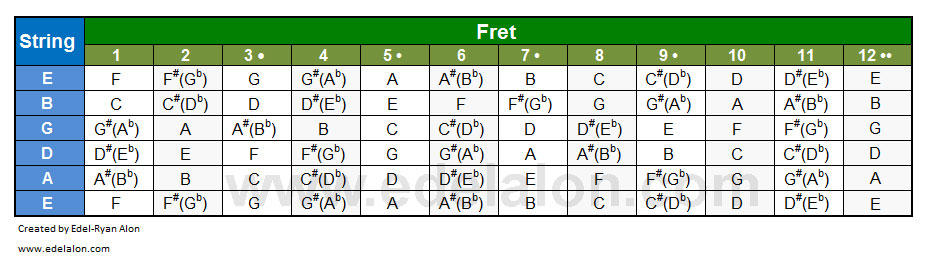
Frets

0

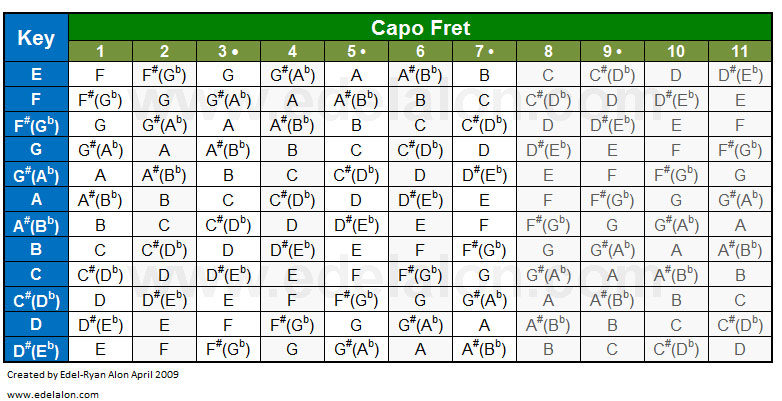
After thinking about the madness of transposing music with a capo, I stepped back and decided to make the chart match the strings on a guitar. After doing that…well, it shows the notes on the specific fret of the guitar.

This should help you learn how to play guitar and also transpose.

Capo Madness

0

I was busy trying to transpose some chords and I thought I’d make a handy sheet for guitarists out there.  There are other sheets like this out there but I thought to make it easier by starting off on E.


Going Back to the Island

0
Courtsey of Alan Chan

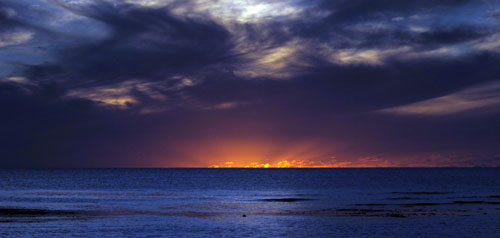
I’ve been thinking about how life would be like if I moved back to the island.  I keep hearing great stories about the military buildup on Guam but I still haven’t seen the action happen just yet.

Skilled labor from Hawaii and probably from Japan and maybe the Philippines,” said Rep. Madeleine Bordallo, Guam’s congressional member. “With the military buildup, many, many opportunities will be made available to people all around the region.

I think there’s still some time until 2014.

References:
http://www.khon2.com/news/local/story/Hawaii-Unemployed-Could-Find-Guam-Construction/06vaR2s8lkeu_x444IcOtA.cspx

KHON removed the original article.  But this one is similar.

I Wondered What Happened to This Submarine.

0


I saw this article from on Navy Times about the submarine San Francisco that used to be stationed on Guam.

San Francisco at sea again after nose repair

By Andrew Scutro – Staff writer

Posted : Wednesday Apr 8, 2009 18:32:52 EDT

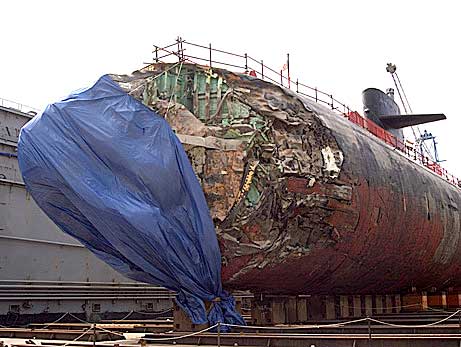
The once-crashed attack submarine San Francisco left Puget Sound for San Diego on Tuesday morning, more than four years after an accident that killed one crewman and injured 97 of 137 sailors on board.

On Jan. 8, 2005, the ship crashed into an undersea mountain 350 miles south of Guam, crushing the nose. After crossing the Pacific Ocean on the surface it arrived at the naval complex near Kitsap, Wash., in September 2005 and went into the Puget Sound Naval Shipyard and Intermediate Maintenance Facility for repairs in October 2006, according to Lt. Kyle Raines, spokesman at Submarine Group 9. He said it went into dry dock in December 2006 and was returned to the water in October 2008.

The nose of the decommissioned sub Honolulu replaced the destroyed portions on San Francisco.

San Francisco was formerly homeported in Guam but will now be based in San Diego with Submarine Squadron 11, Raines said, though was not certain when the San Francisco would rejoin the fleet or be ready for deployment again.

The Kitsap Sun newspaper reported that the nose replacement repairs cost $134 million.

http://www.navytimes.com/news/2009/04/navy_sanfrancisco_repair_040809/