


Friday, February 27, 2026
spot_img
Home Blog Page 241

The Stuff People Experience When on Guam

0

I was reading this article about a guy named George Mallet: Milwaukee Talks: WTMJ-4 anchor/reporter George Mallet.  He was interviewed and part of his interview was about some time he spent in Guam.

Here’s some of the interview:

OMC: I read that you worked in Guam. Really?

GM: Yes, I was working at NBC, and there was a foreign editor there who had started his career in Guam. I wanted to be a reporter, and he said, “Go to Guam.” He called up the news director, and I talked to him over the phone and sent him a tape.

OMC: How old were you then?

GM: It was 1988, so I was 23. I went to Guam, but I didn’t stay there long. TV there was absolutely horrible. I didn’t know anything, but I went in the control room one day and the producer and the director were smoking a bong. I wasn’t a puritan, but I wasn’t going to end up with any useful tape there, so I cut my losses.

I love it.  What’s your story that you remember about Guam?

Backyard Weddings

0

For those of you who don’t know, I help friends out with their wedding planning. Wedding planning/coordinating is really project management in disguise with an additional ounce of happy emotions and at times can turn into a very heated discussion when you involve too many parties (aka inlaws).

Wedding Aisle Runnter

As I talk to more people who are thinking about getting married I am seeing a shift from hotel weddings in really nice venues to backyard weddings. The reason: cost. I hear complaints about costs and the fact that couples don’t want to throw $20K to a wedding. I’m not sure if it’s one of those things where they think they will break up later but more of that they are trying to save money during these times.

I rarely hear about destination weddings anymore. Vegas weddings are great for a quick elopement. But if you want your family there, the next step is to have that backyard wedding. It can be a little cheaper. I’m not saying 50% cheaper but definitely 25% cheaper. Again it all depends on what you are looking for in the end.

weddingathome

Here are some key things to think about:

  1. Catering it yourself is not cheaper. Catering businesses are skilled in knowing how much food to buy for people. If you cater it yourself, there’s a good chance of buying too much food (I know you want to please people).
  2. Tables, chairs, linens, oh my! Renting this equipment isn’t cheap. You might also find that it’s cheaper to buy the equipment than to rent. If you’re really organized and have access to wholesalers, you can buy and resale the equipment. Generally, these are items that are included with hotel weddings.
  3. Parking can be a hassle. I attended a home event where they hired a valet service to handle the cars. I highly recommend this because these companies have insurance. Hiring your nieces, nephews, and cousins can be dangerous.

Good luck with your planning!

Gary Grainger PRS Bass

1

I was shopping for a bass the other day and I came across the Gary Grainger Private Stock Bass. I’m still a novice bass player so I’m just looking at the aesthetics of its assembly and tech specs. I’m drooling at this point: A) it’s a PRS and B) this Gary Grainger guy has a really great bio.

Oh, the pickups…”The instrument has an unusual pickup arrangement, using four single coils combined into two “separated” hum-canceling pickups”.

I’m not sure if you follow the PRS line but PRS are great guitars. I wasn’t so sure about the bass. As far as I could see, this bass would sound good.

A couple of weeks later a friend of mine was asking me if I ever heard of Acoustic Alchemy. He’s a hard core guitar player and uses Acoustic Alchemy as one of the bands he listens to and tries to copy. Well, they had a concert at Yoshi’s in San Francisco and he invited my family to join him.

We did and next thing you know, I see this bass on stage. It’s the Gary Grainger bass. I’m thinking, “Really? Could it be?” Sure enough, it’s Gary Grainger himself on his Gary Grainger Private Stock Bass. I almost fainted.

I sat there excitedly watching his every move and hearing every tone that bass put out. Yeah, there were the two lead guitarists who were the stars of the show but it’s all about the bass player, right?

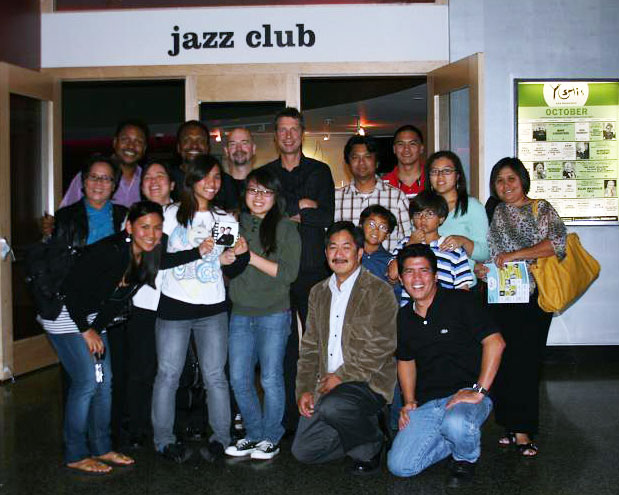
We stayed after the show to meet the band. I was nervous. I’ve never been nervous like this before. Here we are (Gary is the first one on the back row, I’m the fifth from the left on the backrow):

Acoustic Alchemy

That was such an exciting concert. Now I’m a big fan of Acoustic Alchemy.

References:
http://www.acoustic-alchemy.net
http://www.prsguitars.com/grainger5/
http://www.prsguitars.com/grainger4/

Brown Tree Snake

0

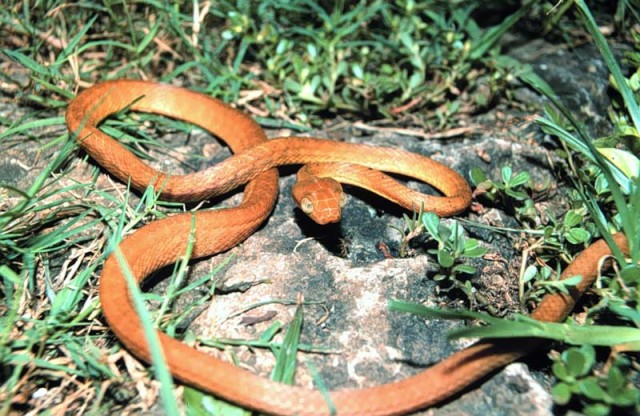
I’ve always wondering about which came first; the chicken or the egg.  Then I wonder about Guam and what Guam was like when there were birds and other creatures before the brown tree snake came along.  While growing up on Guam, I don’t really remember birds.  I remember snakes.

The brown tree snakes have completely taken over on Guam. Believed to have arrived from the Admiralty Islands, New Guinea, or Australia in the holds of post-World War II cargo ships, the snakes conquered an ecosystem where there were no natural enemies. They ate every bird egg available; now Guam is a tropical paradise with almost no tropical birds. The snakes have also devoured native geckos, lizards, and other reptiles. There are an estimated two million brown tree snakes living on Guam’s 136,000 acres. They outnumber people by about twelve to one. About twenty years ago, they started causing regular power outages by shorting themselves out on the island’s antiquated electrical grid. –Peter Dykstra

I really liked how Hawaii introduced the mongoose to the island to take care of the snakes.  They are cute fuzzy creatures.  What would happen if we introduced mongooses to the island.  (I know, bad idea).

References:  http://www.mnn.com/earth-matters/wilderness-resources/stories/green-states-snakes-on-a-boat

FBI Special Agent: Charlene Thornton

0

I’m not sure what a special agent does in this case but it’s interesting that the Star Bulletin cares.

The FBI says Charlene Thornton has been named special agent in charge of its Honolulu Division.

FBI Director Robert Mueller selected Thornton to succeed Janet L. Kamerman as head of the office that covers Hawaii, Guam, the Northern Mariana Islands and much of the Pacific Rim.

Thornton comes to Hawaii from the San Francisco Division, where she was also special agent in charge. She joined the FBI in 1979, and has also worked in San Diego, Phoenix and Birmingham, Ala.

http://www.starbulletin.com/news/breaking/42939217.html

Guam Rhino Beetle

0

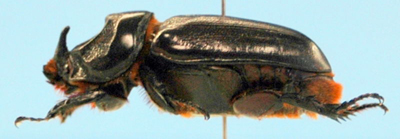
I’m a fan of beetles, it’s sad that the beetles are harming one of Guam’s best natural resources.  I’m glad there are there are scientists like Cathleen Moore-Linn to work on a solution.

In May 2008 the island of Guam became a living laboratory for scientists as they attached acoustic equipment to coconut trees in order to listen for rhinoceros beetles. A grant from USDA IPM allowed Richard Mankin, a recognized world-class expert on acoustic detection of insects, to travel to Guam to collaborate with island scientists on the Guam Coconut Rhinoceros Beetle Eradication Project. The results of this research were recently published in the journal Florida Entomologist.

The coconut rhinoceros beetle, Oryctes rhinoceros, is a serious pest of coconut palms and was discovered on Guam September 11, 2007. University of Guam entomologist, Aubrey Moore worked with Mankin to analyze the spectral and temporal patterns of stridulations produced by the rhino beetles. Recordings were made of beetles and larvae that were reared at the university. Field recordings were also made of beetles and larvae in coconut trees and logs.

Digitized signals were analyzed with several types of software, which distinguished intervals and amplitudes of chirps. The stridulations have distinct, easily recognizable temporal patterns. Results of these studies favor the hypotheses that beetles use stridulations to communicate with other beetles in hidden environments and that acoustic monitoring devices can be useful in mitigating the damage to coconut trees through monitoring and early detection.

“This method of acoustic detection allowed Guam ‘rhino hunters’ to quickly and efficiently locate feeding grubs in an area thought to be rhino-beetle free,” says Aubrey Moore, “and as the beetle broadens its range the acoustic approach to detection may save money and the lives of many coconut trees.”

http://www.eurekalert.org/pub_releases/2009-04/uog-grb041309.php

Frets

0

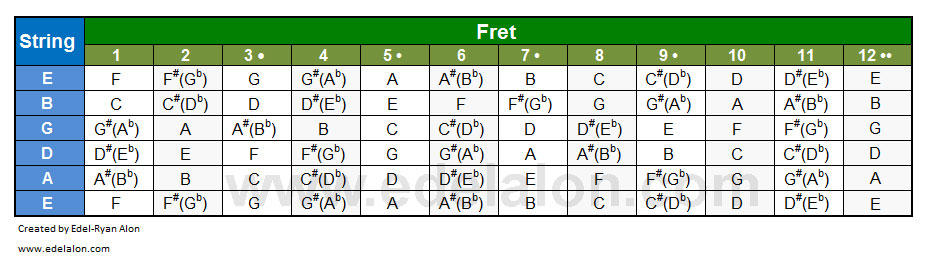
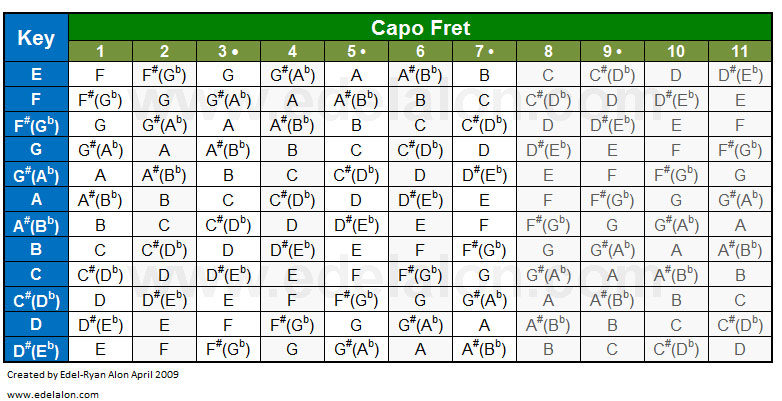
After thinking about the madness of transposing music with a capo, I stepped back and decided to make the chart match the strings on a guitar. After doing that…well, it shows the notes on the specific fret of the guitar.

This should help you learn how to play guitar and also transpose.

Capo Madness

0

I was busy trying to transpose some chords and I thought I’d make a handy sheet for guitarists out there.  There are other sheets like this out there but I thought to make it easier by starting off on E.


Going Back to the Island

0
Courtsey of Alan Chan

I’ve been thinking about how life would be like if I moved back to the island.  I keep hearing great stories about the military buildup on Guam but I still haven’t seen the action happen just yet.

Skilled labor from Hawaii and probably from Japan and maybe the Philippines,” said Rep. Madeleine Bordallo, Guam’s congressional member. “With the military buildup, many, many opportunities will be made available to people all around the region.

I think there’s still some time until 2014.

References:
http://www.khon2.com/news/local/story/Hawaii-Unemployed-Could-Find-Guam-Construction/06vaR2s8lkeu_x444IcOtA.cspx

KHON removed the original article.  But this one is similar.

I Wondered What Happened to This Submarine.

0


I saw this article from on Navy Times about the submarine San Francisco that used to be stationed on Guam.

San Francisco at sea again after nose repair

By Andrew Scutro – Staff writer

Posted : Wednesday Apr 8, 2009 18:32:52 EDT

The once-crashed attack submarine San Francisco left Puget Sound for San Diego on Tuesday morning, more than four years after an accident that killed one crewman and injured 97 of 137 sailors on board.

On Jan. 8, 2005, the ship crashed into an undersea mountain 350 miles south of Guam, crushing the nose. After crossing the Pacific Ocean on the surface it arrived at the naval complex near Kitsap, Wash., in September 2005 and went into the Puget Sound Naval Shipyard and Intermediate Maintenance Facility for repairs in October 2006, according to Lt. Kyle Raines, spokesman at Submarine Group 9. He said it went into dry dock in December 2006 and was returned to the water in October 2008.

The nose of the decommissioned sub Honolulu replaced the destroyed portions on San Francisco.

San Francisco was formerly homeported in Guam but will now be based in San Diego with Submarine Squadron 11, Raines said, though was not certain when the San Francisco would rejoin the fleet or be ready for deployment again.

The Kitsap Sun newspaper reported that the nose replacement repairs cost $134 million.

http://www.navytimes.com/news/2009/04/navy_sanfrancisco_repair_040809/